Final Protests: September 1971-May 1972
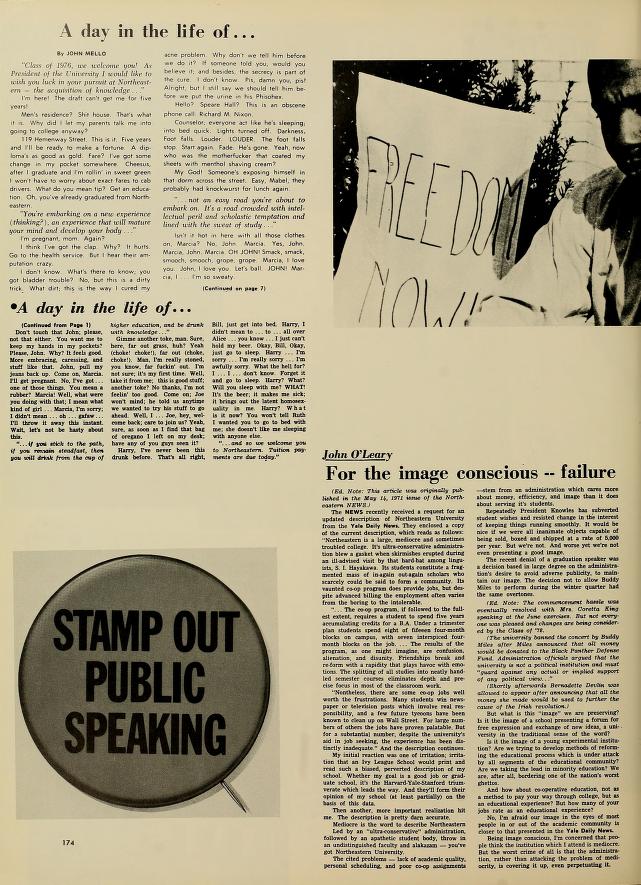
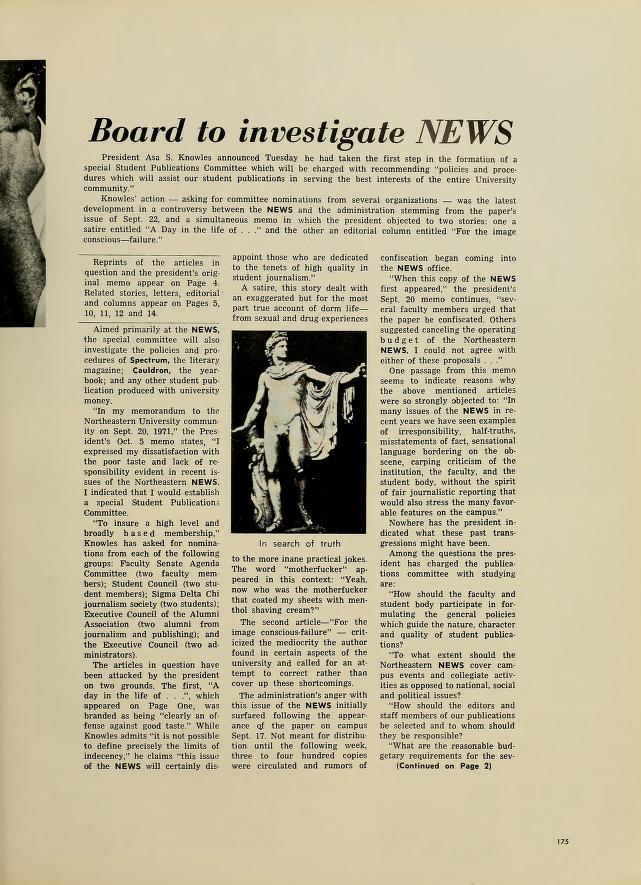
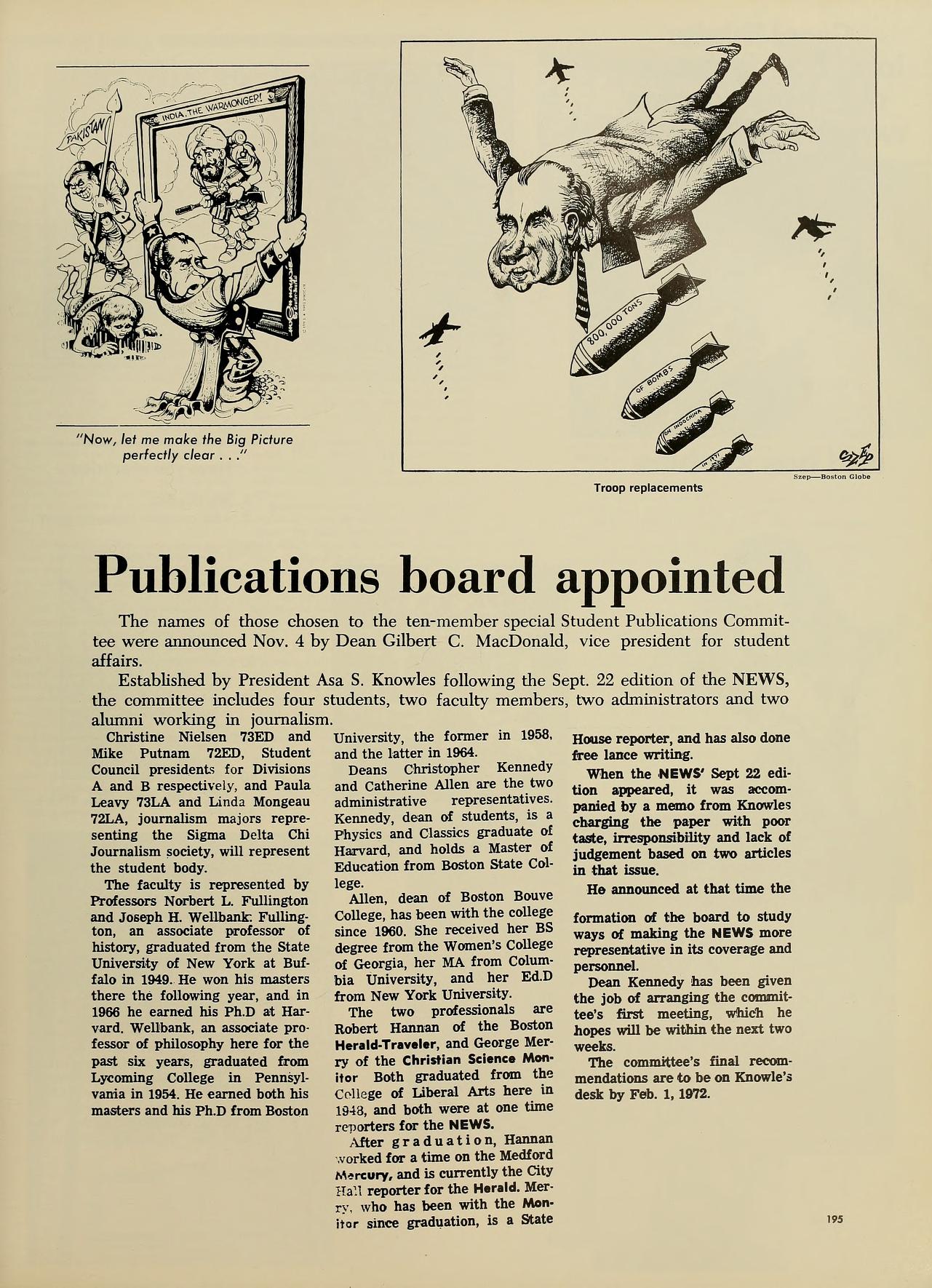
The last major campus anti-War protest occurred in May 1972. Students attended an unprecedented meeting with the Board of Trustees regarding the future of ROTC on campus. Frustrated by the Board’s reactions, a number of students staged a sit-in at the Bursar’s office that afternoon. Several were arrested, including the National Secretary of the SDS who had no affiliation with Northeastern. Three more were arrested that evening, after a group broke into Richards Hall and chained the door from the inside. Following the occupation, about 350 people began marching towards ROTC headquarters, but dispersed around 12:30 a.m. when faced with Boston Police vehicles at the Greenleaf Building.
The next day, students marched and chanted through several buildings, demanding amnesty for the arrested protestors. When Dean Kennedy thwarted these pleas, about 40 students moved to the President’s Office and an open meeting was held in the Lounge. In a final, radical effort to persuade the administration, students gave the following demands: an immediate end to the War, an end to all University complicity in the War, amnesty for those arrested, the cancellation of ROTC and replacement of its scholarships with University ones, and the conversion of the Greenleaf Building into a daycare center. After years of reform discussions, the Board of Trustees had the final say when they voted unanimously that Northeastern’s ROTC program would remain unchanged.
As anti-War activism came to an end, other movements on campus continued. Throughout the early 1970s, African-American students continued to hold the administration accountable to their Thirteen Demands, advocating for the development of the African-American Institute, Department of African American Studies, and the Affirmative Action Office. These students organized celebrations like Black History Week, and protests like the financial aid sit-in of May 1971. Some students focused on racial inequality in the Boston public schools: on March 14, 1972, the NAACP filed a class action lawsuit against the Boston School Committee, eventually leading to the desegregation busing crisis that consumed the city’s attention throughout the mid-1970s.
Meanwhile the country saw a period of federal instability, when the 1973 Watergate hearings led to the impeachment of President Nixon. Changes to the Northeastern administration and elected body were also underway. In 1973, the Student Council dissolved and rebuilt itself as the Student Federation, which would eventually become the Student Government Association. After overseeing the completion of the Diamond Anniversary Development Program, Asa S. Knowles resigned from his Presidency position and was appointed Chancellor in 1975. On April 29-30 of that same year, the U.S. evacuated nearly all of its remaining troops and civilians from Saigon in Operation Frequent Wind. The city was then captured by the National Liberation Front of South Vietnam and the People’s Army of Vietnam, marking the end of the War and beginning of Vietnam’s reunification.